 Pass
Priority Crossroad
Where: On the approach to a crossroad, usually on a rural road or an arterial route, where the road you are travelling on carries the main flow of traffic.
Purpose: To warn that a crossroad is coming up, and to tell you which of the two roads has priority. The thick bar on the sign is the priority road; the thin bar is the road that crosses it. On this sign the thick bar runs in your direction of travel, so the priority road is yours.
Action Required by Driver: Read the sign before you read the junction. Having priority does not mean the junction is safe — it means other drivers are obliged to give way to you, which is not the same thing. Ease off, cover the brake, and look right, left and right again. A driver on the minor road who has not seen the yield sign is the single most common cause of a crossroad collision.
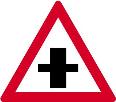
The temporary version (TW102)
The same sign on a yellow face is the temporary one, used at road works, at a collision scene, or anywhere the normal arrangement of the junction has been changed. The symbol means exactly the same thing — the yellow tells you the situation is not permanent, so give it more attention rather than less.

Telling W102 and W103 apart
These two signs look almost identical and are easy to confuse in the test. There is only one thing to look at: which bar is thicker.
Thick bar running the way you are going — priority crossroad, your road has priority.
Thick bar running across your path — secondary crossroad, the other road has priority and you must give way.